


Beyond Logistics: Applying Neuroscience Strategies to Your Meetings & Events Portfolio
Organizations invest millions in events each year, including sales kickoffs, product launches, leadership summits, incentive travel, and user conferences. These events aren’t just about logistics; they’re strategic levers for growth. But stakeholders struggle to measure value and outcomes across a portfolio of events, making it difficult to demonstrate ROI, optimize budgets, and align initiatives with strategic business goals. That’s where neuroscience-based strategies come into play.
We previously shared recommendations for introducing brain-friendly design to individual events. In this blog post, M&IW’s Jeanette Davis, Sr. Director of Customer Success, and Marie Johnson, CMP, Sr. Marketing & Event Strategist, explore how neuroscience benefits enterprise meetings and events (M&E) programs.
How Neuroscience Benefits M&E Programs
Unlike individual event design, managing an enterprise M&E program involves various stakeholders, departments, regions, and audiences. The complexity multiplies as shared resources, stretched budgets, competing priorities, and fragmented data make alignment and measurement difficult.
“When we partner with our enterprise customers, they often tell us their biggest challenge isn’t a lack of effort; it’s proving impact,” says Jeanette.
This is further complicated by:
- Compressed event schedules that lead to content overload and poor retention.
- Wellness initiatives that are often one-off and fail to create a lasting impact.
- Event technology that is treated as a tool rather than a strategic enabler.
- Networking that feels transactional, missing opportunities for trust and collaboration.
- Siloed engagement and incentives programs, reducing impact across the portfolio.
Incorporating intentional, neuroscience-based event design helps organizations improve decision-making, streamline planning, and create clarity. This in turn ensures budgets are optimized and attendee experiences deliver measurable outcomes for the entire portfolio, not just one event.
The result is an enterprise M&E portfolio that accelerates sales, improves learning and retention, and delivers measurable business outcomes because it’s designed for how people think, learn, and connect.
Designing Enterprise Meetings & Events Programs for Growth and Impact
Neuroscience transforms your events strategy from a foundational function to a key driver of business growth and brand leadership. It’s not just about logistics; it’s about elevating your presence, building meaningful connections, and creating unforgettable brand experiences that showcase your innovation and market leadership.
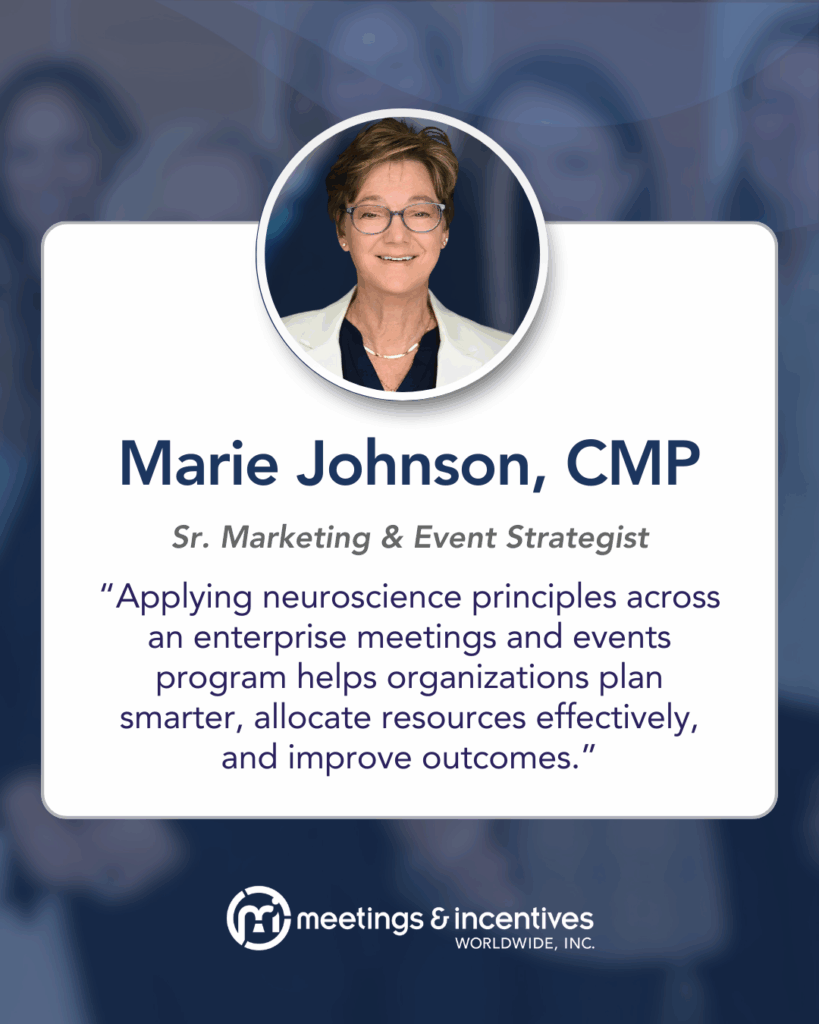
“Applying neuroscience principles across an enterprise meetings and events program helps organizations plan smarter, allocate resources effectively, and improve outcomes,” explains Marie. “Instead of treating events as isolated experiences, this approach turns a large portfolio into a connected strategy that drives measurable business results.”
Below are four practical ways to integrate neuroscience-based approaches into your enterprise M&E program.
1. Optimize Your Event Calendar for Learning and Connection
Enterprise event programs aren’t just internal. They’re critical for building customer relationships and driving sales. Neuroscience shows that the brain needs time to consolidate memories, a process called spaced learning. When events are clustered too closely, such as hosting product launches and sales meetings in the same quarter, attendees struggle to absorb and apply what they learn.
By strategically mapping events across the year, organizations give sales teams and customers time to learn, practice, and adopt new offerings before the next big initiative.
“We have a client that hosts their signature customer event in the US, Europe, and Asia over several months,” says Jeanette. “They find this approach delivers higher retention of product knowledge, faster adoption of new solutions, stronger customer relationships, and reduced attendee fatigue.”
2. Embed Wellness at Scale
More than a morale booster, incorporating wellness in events improves cognitive performance and decision-making. Stress and fatigue raise cortisol levels, which impair productivity, so integrating health initiatives benefits both your attendees and your organization. A holistic approach that prioritizes physical, mental, and emotional well-being creates a sustainable impact.
Instead of a one-off yoga session or fun run at a specific event, consider creating an enterprise-wide, year-long wellness initiative or challenge aligned with your corporate mission. For example, introduce a Movement Challenge that attendees can complete in their own time, but also offer optional sessions during your events that count toward the challenge.
“When wellness is embedded into your enterprise event strategy, it builds a stronger culture, fosters collaboration across teams, and strengthens working relationships,” says Marie. “It also creates visibility with customers as well as promotional opportunities to showcase your commitment to employee wellbeing.”
3. Leverage Event Technology as a Strategy
Technology is backbone of a connected event ecosystem. A unified platform personalizes experiences and captures data that drives decisions. From a neuroscience perspective, this matters because the brain craves certainty, yet loves novelty. Consistent, predictable access reduces cognitive load, while fresh, personalized content keeps attendees engaged and motivated.
Design a branded hub or container app for all your events to deliver a seamless experience across your enterprise portfolio. Be sure to include consistent profiles, gamification modules, AI-powered recommendations, and integrated analytics.
“Event technology platforms are data gold mines,” says Marie. “Interactions, session attendance, engagement scores, and content downloads all feed into analytics that inform more intelligent planning and measurable ROI across your entire event portfolio.”
4. Create Connection Points That Matter
Humans are wired for social connection, and positive interactions spike oxytocin, the trust hormone. Unlike one-off networking sessions, enterprise-level strategies require activities that build relationships over time, creating opportunities for deeper engagement and shared insights across regions and events.
Introduce challenges that encourage collaboration and knowledge sharing, both among internal teams and with customers and partners. Use interactive sessions, gamified networking, and real-time leaderboards for meaningful engagement that extends beyond a single meeting and connects participants across the entire event portfolio.
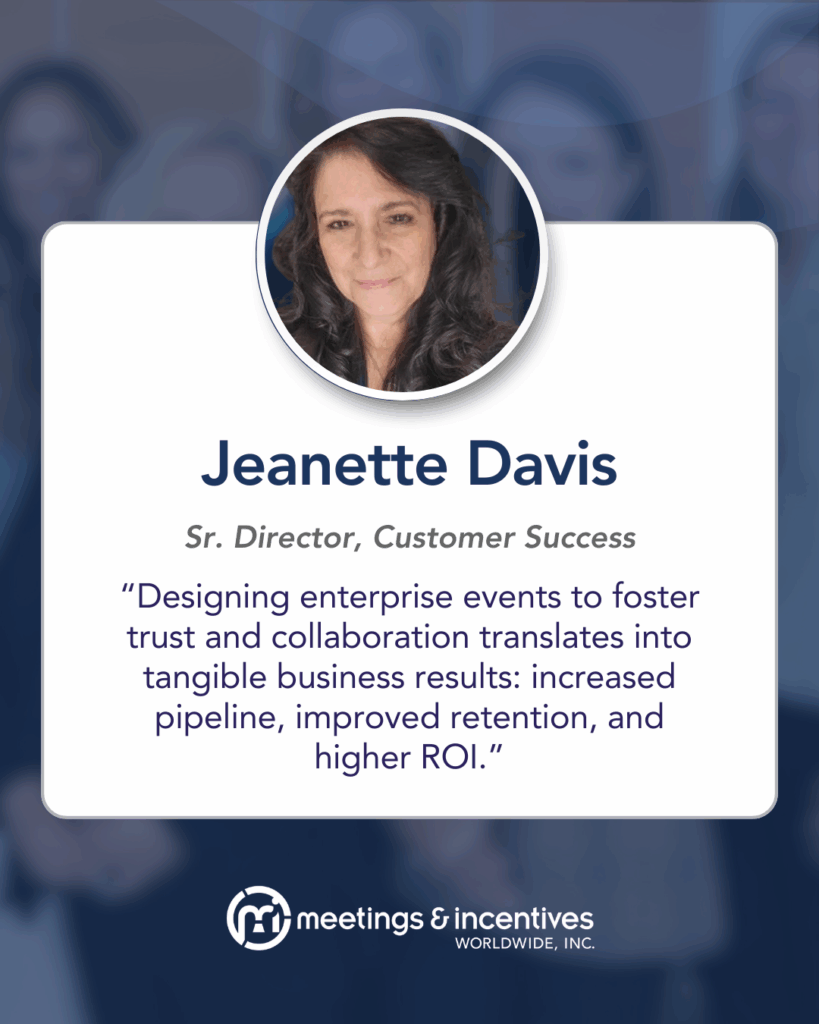
“At scale, human connection becomes a competitive advantage,” says Jeanette. “Designing enterprise events to foster trust and collaboration translates into tangible business results: increased pipeline, improved retention, and higher ROI.”
Prove Impact by Linking Neuroscience Strategies to Clear KPIs
Meaningful human connections accelerate pipeline and deal velocity, deepen product understanding, and create measurable engagement across the entire event portfolio. The ability to track and quantify these interactions is critical not only to proving ROI but also to optimizing future events.
Example of metrics to measure for common KPIs include:
- Engagement: Participation in challenges, networking sessions, and learning modules
- Sales: Pipeline growth, deal speed, and product adoption rates
- Retention: Post-event knowledge checks and certification completions
- Wellness: Participation rates and attendee feedback
- Technology: Platform adoption, data utilization, and cost savings
Elevate Your Enterprise M&E Program with Meetings & Incentives Worldwide
Intentional event design isn’t about adding complexity; it’s about aligning human behavior with business goals. Neuroscience explains why these strategies work, but you don’t need a science degree; you need a partner who knows how to apply it. That’s where M&IW comes in.
Our event planners leverage the M&IW Event Design Framework to create experiences that engage, connect, and deliver measurable business outcomes. To learn more about our framework and how neuroscience can elevate your M&E program, contact us.
For more brain-friendly ideas at the individual event level, read Neuroscience for Events: Increasing Attendee Engagement & Belonging.
Meet the Experts

Jeanette Davis
Sr. Director, Customer Success
Meetings & Incentives Worldwide, Inc.

Marie Johnson, CMP
Sr. Marketing & Event Strategist – Neuroscience
Meetings & Incentives Worldwide, Inc.
Related Articles
- Designing Attendee Journeys for Large Events: Keeping 1,000 Attendees Engaged Hour by Hour
- 4 Ways to Build a Better Event Agenda
- Neuroscience for Events: Increasing Attendee Engagement & Belonging
To stay up to date on the latest trends and insights in meetings, events, and incentives, follow us on LinkedIn.