

Why Events Are Your Secret Weapon for Accelerating B2B Sales
In-person events aren’t just a break from the office. They’re a strategic lever for accelerating sales. When executed thoughtfully, these events transform prospects from interested to committed quickly while also fostering stronger, longer-lasting relationships.
This post explores why in-person engagement remains a powerful differentiator in today’s digital-first world. You’ll discover compelling data on the impact of sales events, practical strategies for aligning event design with stages of the sales cycle, and key metrics to measure ROI. While these insights apply broadly, our focus is on driving results for B2B organizations.
Why In-person Events are Effective B2B Sales Tools
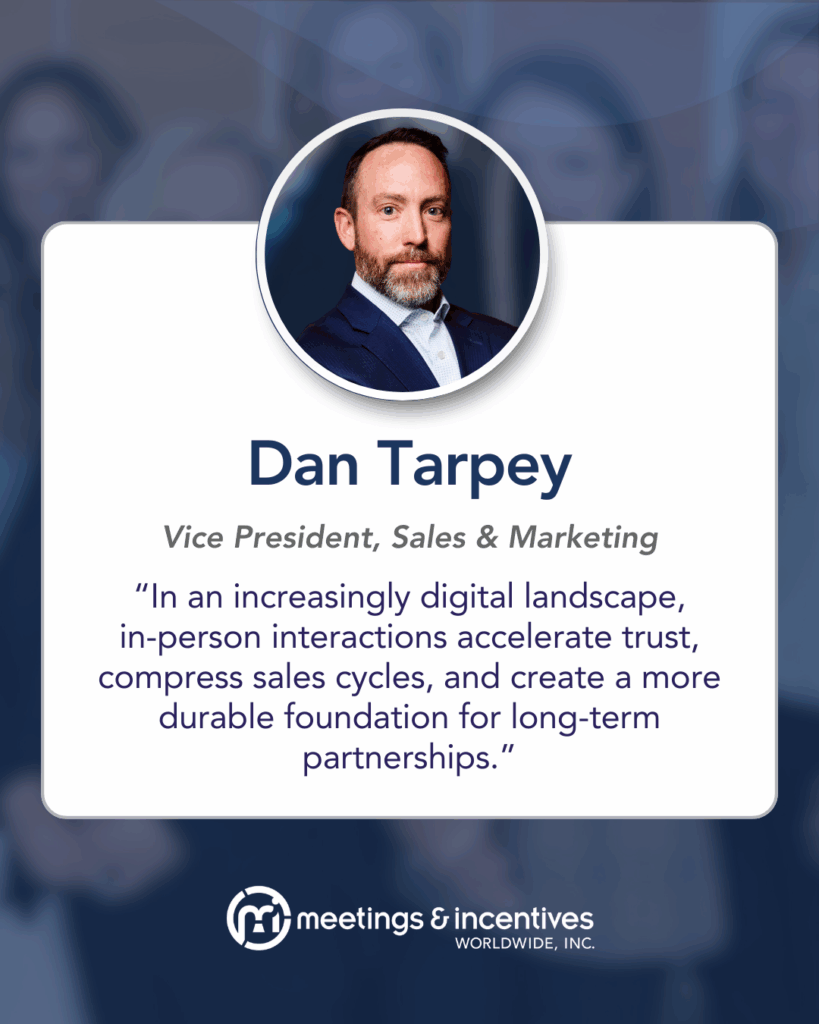
“At the highest levels of business, meaningful growth is still driven by one timeless principle: human connection,” says Dan Tarpey, Vice President, Sales & Marketing at M&IW. “Prioritizing in-person engagement significantly strengthens revenue performance. In an increasingly digital landscape, in-person interactions accelerate trust, compress sales cycles, and create a more durable foundation for long-term partnerships.”
Proving the Success of Sales Events
The data supports this belief in the power of human connection.
One study shows that professionals anticipate 36% greater revenue when critical conversations are held in person versus digitally.1 Another study shows that after participating in in-person events or experiences, 85% of consumers are more likely to make a purchase, and 90% of participants have a more positive brand perception.2
These results are consistent across industries. No matter the product or service being offered, buyers want to know the people behind it before making a purchase or signing a deal. A recent paper in the Journal of Marketing reports that, “In almost every case, B2B buyers interviewed said, ‘We need to meet the people. We need to see into the eyes of these people and judge whether we’re going to get a good deal.’”3
Because of deeper engagement and trust gained, in-person B2B sales events often lead to upsells or larger deals, further highlighting their value.
Aligning Event Design with Sales Stages
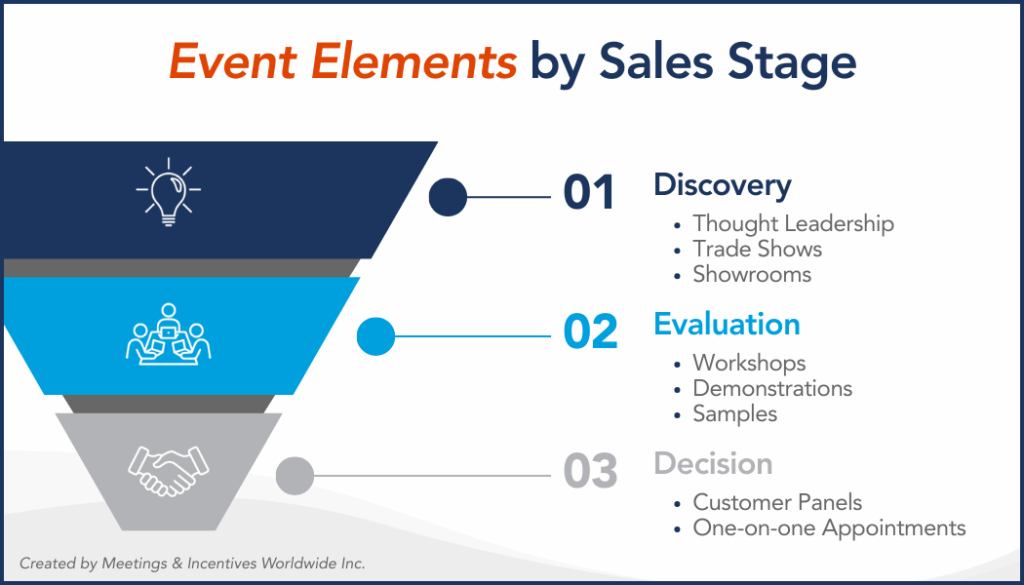
B2B sales events can impact every stage of the sales cycle but are most impactful for the discovery, evaluation, and decision stages.
Discovery Stage
Today’s buyers conduct the discovery stage on their own, researching online before ever interacting with a salesperson. Unless you’re announcing a new offering, an in-person sales event isn’t about telling attendees about your product or service; it’s about discovering their unique pain points and how you can address them.
Thought-leadership sessions are one opportunity to share common pain points your offerings address. They’re also an opportunity for your executives to share what differentiates your company from competitors.
Trade shows and interactive showrooms can have the same result. Consider a twist on the traditional approach: Instead of grouping the showroom by product or service, group it by specific challenges your customers may be experiencing so attendees know exactly where to go to have their questions answered.
Evaluation Stage
By the evaluation stage, potential buyers are already familiar with what your product or service is. Now, you need to prove its value. Hands-on workshops and interactive demonstrations are ideal for this stage and should be the primary focus of your event.
One study reports that “47% of attendees say sampling, using, or seeing a demonstration of the product most influences their decision to purchase at events. In comparison, only 16% say having a better understanding of the product influences their purchase.”4
Use your event as an opportunity to give attendees experiences that can’t be replicated online or even in a traditional in-person meeting with a sales representative.
Decision Stage
Help attendees seal the deal with customer panels and one-on-one appointments with your executives or sales teams.
Forbes reports that 70% of global consumers say “recommendations from real people carry more weight.”5 Use your customer panels as an opportunity to highlight real-world success stories and testimonials. These won’t be as impactful or trustworthy coming from your team. Your customers should be onsite to share their stories live in their own words.
One-on-one meetings can be offered throughout your event to answer questions, deepen relationships, and close deals. One study shows that “one in-person meeting has the same impact and value as three virtual meetings,”6 so be sure to include this valuable opportunity alongside more experiential event elements.
Metrics that Prove Sales Acceleration
There are a number of metrics that can be measured to prove the ROI of in-person sales events. These include but are not limited to:
- Onsite sales: The number of sales made or deals closed during the event
- Conversion rate uplift: The percentage of event attendees who made a purchase or closed a deal compared to your baseline conversion rate
- Post-event meetings or calls: The number of new sales meetings or calls held with attendees after the event
- Deal size: The size of and revenue from event-influenced deals compared to average sales
- Pipeline velocity: The average time from lead to close for event attendees versus non-attendees
Setting the Stage for Successful Sales Events
In-person events are a catalyst for meaningful business growth. By fostering authentic connections, showcasing value through immersive experiences, and creating space for real conversations, these events help decision-makers move from interest to commitment faster and with greater confidence.
For organizations seeking to accelerate revenue and strengthen partnerships, investing in well-designed B2B sales events is a proven strategy. When paired with clear objectives and measurable outcomes, these experiences transform relationships and set the stage for long-term success.
Sources
1 Hospitality Net, 2024
2 Event Marketer, 2018
3 The University of Kentucky School of Business, 2025
4 Event Marketer, 2018
5 Forbes, 2025
6 Hospitality Net, 2024
Related Articles
- Beyond Logistics: Applying Neuroscience Strategies to Your Meetings & Events Portfolio
- From Process to Strategy: Harnessing the Power of Data in Strategic Meetings Management Programs (SMMP)
- Guide to Creating Enterprise Event RFPs: What to Ask to Find the Perfect Event Management Partner
To stay up to date on the latest trends and insights in meetings, events, and incentives, follow us on LinkedIn.