


How Executive Retreats Align Leadership for Long-Term Impact
Today’s business landscape leaves little time for executive leadership to collaborate as peers. While there’s still a place for traditional boardroom meetings and quarterly reviews, those occasions rarely provide the space for transformative leadership experiences that inspire innovative thinking and strategic alignment.
Executive retreats, on the other hand, provide essential time away from daily operations to focus on long-term strategy and align on company vision. Unlike company retreats, executive retreats are reserved for senior leadership. Also referred to as corporate offsites, they go beyond teambuilding to also focus on business outcomes.
In this blog post, we look at how investing in curated, experiential executive leadership retreats allows leadership teams to step back, think deeply, and collaborate on the big picture in a distraction-free environment. We explore how non-competitive, shared experiences become a catalyst for transformation.
The ROI of Executive Leadership Retreats
Offsite executive leadership retreats are powerful, focused investments that deliver measurable returns. They offer significant business value by taking leaders from daily operations to focus on specific objectives, such as aligning on long-term strategy.
Benefits and Business Value
Benefits of executive retreats and how they impact a company’s overall performance include:
- Strategic alignment: Research shows that “companies where top executives are aligned on vision and strategy are 70% more likely to outperform peers in revenue growth.”1
- Shared sense of purpose: By aligning on strategy, retreat attendees also align on their purpose. Harvard Business Review (HBR) reported that “teams with a strong sense of shared purpose and values have a 17% increase in performance.”2
- Stronger corporate culture: Retreats teach executives how to create and support their organizational culture in real time. HBR also found that “companies with a strong corporate culture see a 4x increase in revenue growth.”2
- Improved decision making: HBR shared that organizations with highly effective decision makers “generate average total shareholder returns nearly six percentage points higher than those of other firms.”3
- Increased employee retention: Leadership investment improves engagement and, in turn, retention for both leaders and their teams.4
Evolving Retreats from Tame to Transformational
The most effective executive retreats take leaders out of their familiar surroundings and into an experiential environment.
The magic happens because it taps into more than intellect; it engages the senses, emotions, and social instincts. It creates an environment that challenges assumptions, explores new ideas, and sparks the strategic thinking that drives organizational performance and business breakthroughs.
New Ideas for Fresh Insights
If familiarity breeds complacency, then novelty inspires innovation.
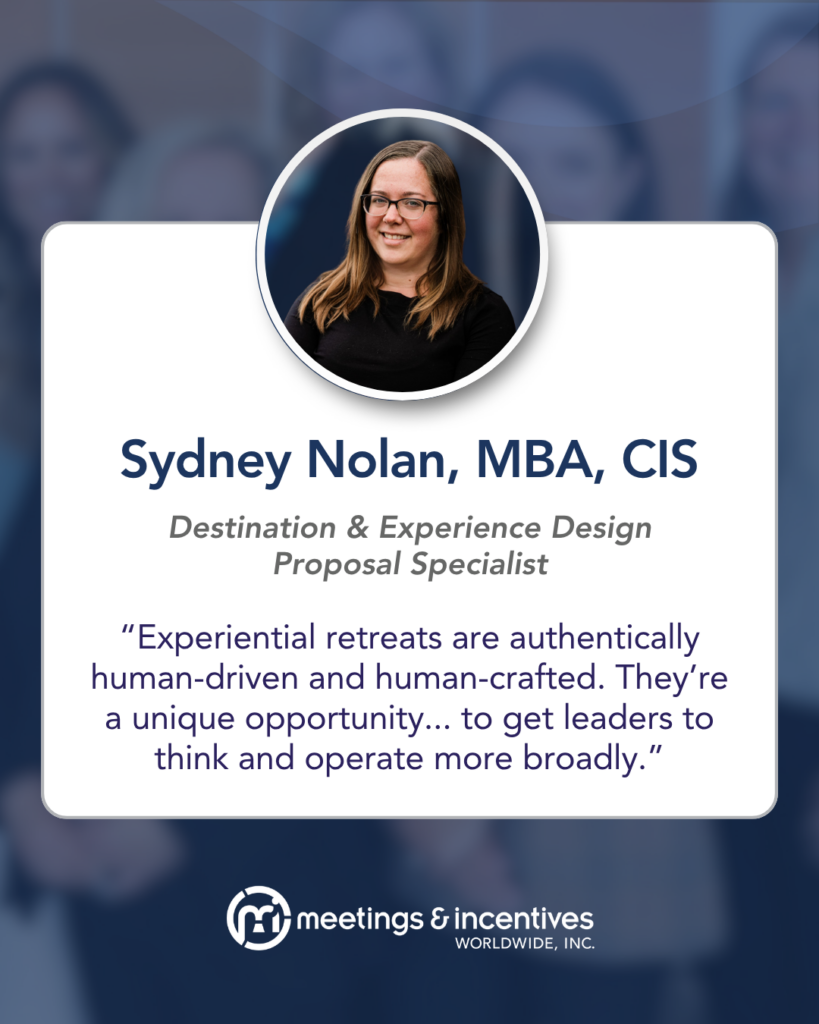
“You can’t be what you can’t see,” says Sydney Nolan, MBA, CIS Destination & Experience Design Proposal Specialist, M&IW. “Experiential retreats are authentically human-driven and human-crafted. They’re a unique opportunity to translate a company’s values into demonstrable actions and to get leaders to think and operate more broadly through a host venue or destination, activities, and engagements.”
“Shifting to a less familiar setting, trying new activities, and exploring different ways to share and learn can shake up corporate dynamics in surprisingly insightful ways,” adds Sydney.
Experiential retreats are also an opportunity for talent pipeline-building, where promising future leaders get an early seat at the table and influence future strategic direction, initiatives, and projects.
A Future-Ready Strategy
Executive retreats should be treated as a vital, recurring part of your annual operating budget. The companies that will dominate the next decade—and even upcoming quarterly cycles—are those with aligned, high-functioning leadership teams. Market volatility and talent competition demand strategic agility that only comes from leaders who think and act as a cohesive unit.
Meet the Expert

Sydney Nolan, MBA, CIS
Destination & Experience Design Proposal Specialist
Meetings & Incentives Worldwide, Inc.
Sources
1 Retreats and Venues, 2025
2 Forbes, 2024
3 Harvard Business Impact, 2025
4 Gallup, 2026
Related Articles
- Insight, Influence, and Impact: The Strategic Power of Advisory Boards and Investor Days
- How Inclusive Strategy Defines Competitive Advantage for Global M&E Programs
- From Optics to Impact: The Value of Sustainability in Enterprise-level Meetings & Events Strategies
- Why Events Are Your Secret Weapon for Accelerating B2B Sales
To stay up to date on the latest trends and insights in meetings, events, and incentives, join our mailing list or follow us on LinkedIn.