


Proving the Value of High-Impact Meetings and Events
Enterprise organizations face no shortage of pressure to justify investment decisions. Marketing, technology, talent, and transformation initiatives are increasingly expected to demonstrate measurable business outcomes, often under heightened budget scrutiny and executive oversight. Meetings and events (M&E) programs are no exception.
Stakeholders now want to know: Did the meeting accelerate a strategic priority? Did it improve adoption of a business initiative? Did it create alignment, strengthen execution, or influence performance?
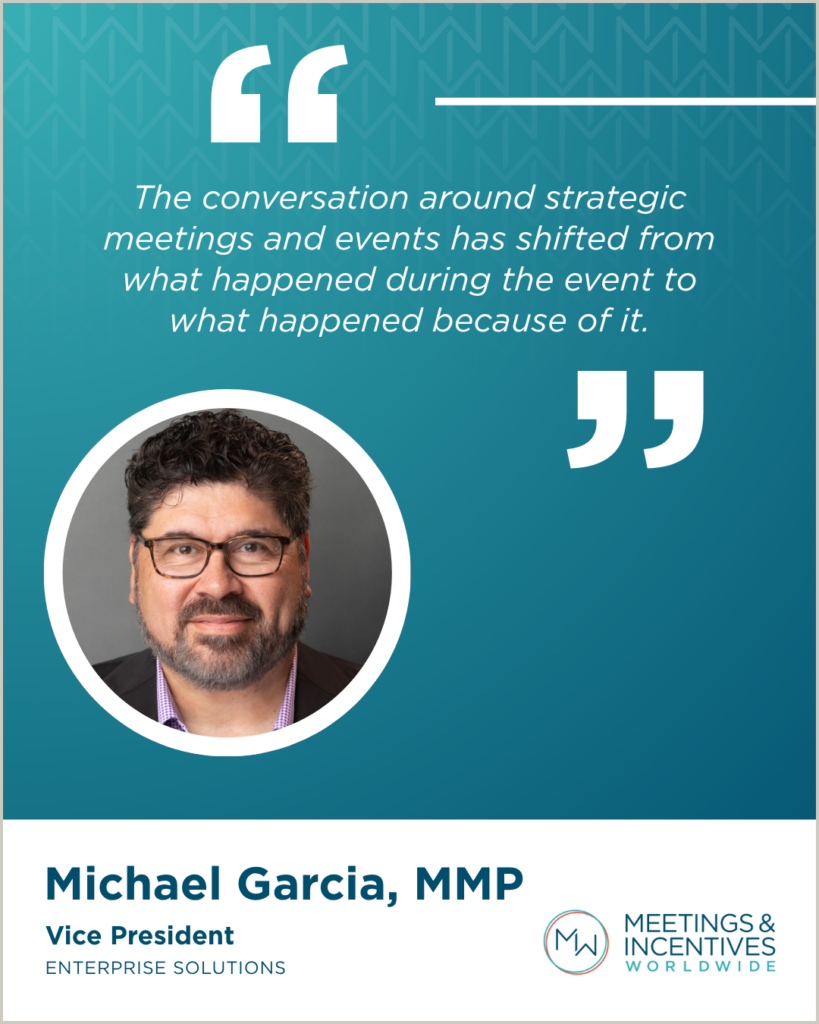
“The conversation around strategic meetings and events has shifted from what happened during the event to what happened because of it,” said Michael Garcia, MMP, Vice President, Enterprise Solutions, M&IW. “The most valuable meetings are business investments designed to drive measurable outcomes.”
Shifting the Conversation from Attendance to Impact
Historically, event success was measured using operational metrics: registration and attendance, session participation, satisfaction scores, budget performance, and onsite execution. These indicators remain important, but they are measures of efficiency, not effectiveness.
Leading organizations place greater emphasis on execution, accountability, and organizational alignment as drivers of business performance. Research highlights that organizations that achieve strong alignment around direction, leadership, and execution are better positioned to sustain performance and navigate complexity.1
At the same time, the need for organizational alignment continues to grow. Research found that actual strategic alignment across organizations is often significantly lower than leaders perceive, creating barriers to effective execution.2
This is where meetings and events become strategically important because the business value of M&E programs extends far beyond the events themselves.
“When designed with clear business objectives, meetings and events are one of the most effective ways to translate strategy into action across large, complex organizations,” said Garcia.
What to Measure to Prove the Business Value of Meetings and Events
To prove meetings and events are impactful business investments, measurements should focus on business outcomes.
“The most effective measurement frameworks begin with the business outcome and work backward to define event success,” said Garcia.
Metrics may include:
Alignment: Measure whether participants understand strategic priorities, organizational goals, expected actions, and individual accountability. Pre- and post-event assessments can identify changes in understanding and confidence levels.
Behavior change: Evaluate whether participants adopt new processes, follow new governance requirements, change customer engagement behaviors, or implement newly communicated priorities. Behavioral change provides one of the clearest indicators of meeting effectiveness.
Knowledge transfer and adoption: For training, product, sales, and leadership events, measure information retention, technology adoption, program implementation, and learning application. The goal is applied knowledge, not content consumption.
Strategic initiative acceleration: Consider whether a meeting helped advance transformation initiatives, accelerate project timelines, improve cross-functional coordination, or remove barriers to execution. In many cases, the value of events is seen through faster organizational progress.
Productivity and performance indicators: Depending on organizational objectives, metrics may include sales productivity, customer engagement, program adoption, retention, compliance, or operational efficiency.
How to Design Meetings and Events That Create Lasting Momentum
High-impact events are intentionally engineered to create momentum that extends beyond the event itself. To achieve this, Garcia recommends a five-step approach:
- Start with business objectives. Every strategic meeting should begin with a simple question: What business outcome are we trying to achieve?
- Design for decision-making and action. Information alone doesn’t change behavior, but active participation does.
- Connect engagement to outcomes. Engagement strategies should be designed to support specific business objectives rather than simply increase activity.
- Use technology to extend impact. The most effective event strategies use technology to sustain momentum after the event by capturing data, reinforcing learning, tracking adoption, and measuring outcomes over time.
- Execute consistently at scale. Even the strongest strategy loses credibility through inconsistent execution.
Justifying the Investment in Meetings and Events
For many organizations, the pressure to justify M&E investments will continue to grow in tandem with expectations around accountability, measurement, and business performance.
Ultimately, the value of a meetings and events program is reflected in what happens next: the decisions that move forward faster, the initiatives that gain traction, the teams that execute with greater confidence, and the progress that becomes possible when people share a common understanding of where the organization is headed and why it matters.
Meet the Expert

Michael Garcia, MMP
Vice President, Global Enterprise Solutions
Meetings & Incentives Worldwide
Sources
1 “Alignment advantage: Healthy organizations navigate a path to success,” McKinsey & Company, 2025
2 “Is Your Company as Strategically Aligned as You Think It Is?” Harvard Business Impact, 2023
Related Articles
- 2027 Spend Trends for Meetings & Events Programs
- Insight, Influence, and Impact: The Strategic Power of Advisory Boards and Investor Days
- How Executive Retreats Align Leadership for Long-Term Impact
To stay up to date on the latest trends and insights in meetings, events, and incentives, join our mailing list or follow us on LinkedIn.